Top Supplier of Black Galaxy Granite in India
Black Galaxy Granite is a near-black stone with gold and silver flecks that catch the light. It has been a staple of Indian stone exports since the late 1970s and is a familiar sight in hotel lobbies and well-finished kitchens.
It's one of the few Indian stones recognised by name outside India, specified by architects across the Middle East, Europe, and the US. Since each slab is cut from a natural block rather than a set pattern, no two look exactly alike a variation buyers often prefer over uniform, engineered surfaces.
At Tripura Stones, we work with Black Galaxy Granite in India regularly. This guide covers where it comes from, how it's priced, how it performs, where it works best, and how to maintain it whether you're an architect, a builder, or a homeowner deciding on stone for your project.
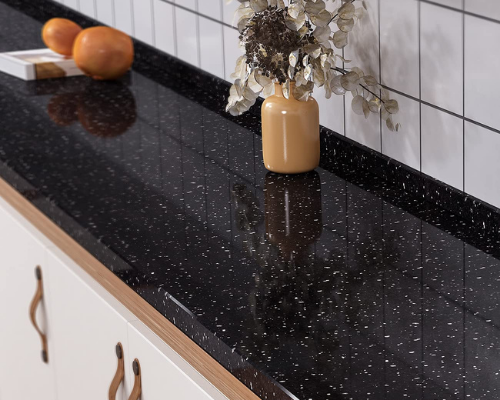
What Makes Black Galaxy Granite a Premium Indian Stone?
Nearly all of it comes from one place: the Chimakurthy belt in Prakasam district, Andhra Pradesh. That's not marketing it's just geology. This isn't a stone that gets dyed or artificially darkened to hit a colour target; the black base and the gold flecking are both entirely natural, laid down over hundreds of millions of years. That's also why you'll sometimes see it sold under other names: Star Galaxy Granite, Galaxy Gold Granite same belt, same stone, different label.
What actually separates a good block from a mediocre one comes down to a few things: how evenly the flecks sit across the surface, how deep and consistent the black runs, and how few natural fissures show up on the face. And because every slab is cut from a quarried block rather than manufactured to spec, no two slabs look quite the same. That's not a flaw to work around it's just what natural stone does.
The Geology Behind Black Galaxy Granite
Here's something most suppliers won't mention: Black Galaxy Granite in India isn't actually a granite. It's a gabbro. The trade calls it granite anyway, because it behaves like one similar hardness, similar polish, similar finishing process so the name has stuck. The mineral makeup is mostly plagioclase feldspar mixed with biotite and other dark minerals, which is what gives you those metallic gold and white specks against the black.
| Property | Typical Value |
|---|---|
| Origin | Chimakurthy, Prakasam District, Andhra Pradesh |
| Base Colour | Deep black with gold/white mineral flecks |
| Density | Approx. 2.9–3.0 g/cm³ |
| Hardness | Approx. 4.5–5 on the Mohs scale |
| Water Absorption | Approx. 0.05%–0.1% (very low) |
| Common Finishes | Polished, honed, flamed, leathered, bush-hammered, brushed |
| Standard Forms | Slabs, tiles, countertops, cladding panels, flooring |
That water absorption number matters more than people realise. A stone this dense and this tight barely lets moisture in, which is exactly why it holds up in bathrooms and outdoor installs where a more porous stone would eventually stain or crack under monsoon conditions.
What Determines Black Galaxy Granite Price in India?
Black Galaxy Granite in India is sold on a per-square-foot or per-slab basis, and quoted rates vary widely across the market depending on where and how the stone is sourced. Rather than quote a single figure that goes stale the moment demand shifts, it's more useful to know what actually moves the price up or down on a quote:
Thickness
16–18mm tiles cost less than 20mm or 30mm slabs used for countertops and heavy-duty flooring.
Finish
Polished is the baseline; leathered, flamed and bush-hammered finishes involve extra processing and cost more.
Slab Grade
Even flecking, deep consistent black, and minimal fissures push a block into a higher grade.
Order Volume
Bulk orders for large commercial or export projects typically get better per-square-foot rates than small retail lots.
Slab Size & Random vs. Calibrated
Random-size blocks are cheaper than calibrated, gauged slabs cut to precise dimensions.
Delivery Location
Freight from Rajasthan or Andhra Pradesh to site adds to the landed cost, especially for export orders.
Because rates shift with market conditions and project specifics, the most reliable number is a current, project-specific quote.
Where Black Galaxy Granite Performs Best
Kitchen Countertops
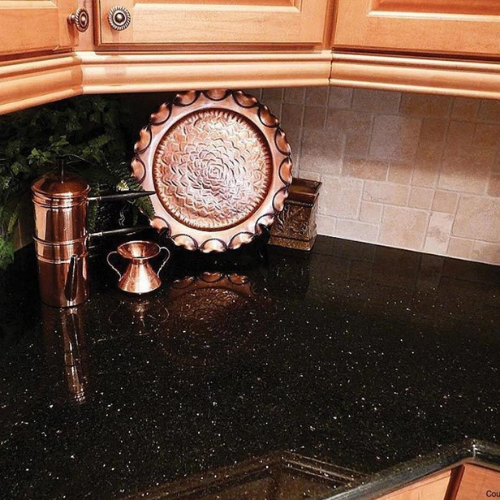
Polished, it shrugs off day-to-day knife marks and cookware scuffs, and the dark surface hides minor stains a lot better than pale stones do.
Flooring
In homes and busy commercial spaces alike, the hardness means it holds its finish under heavy foot traffic for years, not months.
Wall Cladding
Interior feature walls and building exteriors benefit from how the surface catches light, especially under angled lighting.
Outdoor Use
Low water absorption makes it a safe bet for stairs, garden edging, and pool surrounds, even through Indian monsoons.
Hospitality Projects
Hotels and office lobbies use it often; it reads as upscale without fighting for attention against everything else in the room.
Facades & Lobbies
Large-format polished panels are a common choice for entrance facades where a strong first impression matters.
Why Architects & Designers Prefer Black Galaxy Granite
Designers reach for Black Galaxy Granite in India when a project needs something that reads as neutral but still feels expensive. It works with brass and gold fixtures just as well as it works with chrome and stainless more flexibility across styles than a lot of competing black stones offer. For architects on commercial jobs, the durability also means fewer maintenance headaches down the line.
It also photographs well, which matters more than people expect when a project is going to be marketed like real estate listings, hotel brochures, restaurant interiors. The gold flecking picks up light in a way that reads as rich rather than flashy, and a near-black surface with natural flecking hides seams, minor scratches, and day-to-day wear far better than a pale or single-tone stone would so the finish still looks sharp years after handover, not just on the day it's installed.
Black Galaxy vs. Other Popular Black Granites
Buyers often land on this page while comparing black stone options. Here's how Black Galaxy stacks up against two other common choices:
Black Galaxy
- Deep black with gold/silver flecks
- Sourced from Andhra Pradesh
- Best for a bold, "starry" look
- Ideal for feature walls, countertops
Absolute Black
- Uniform, near-solid black
- No visible flecking
- Best for a minimal, sleek look
- Common in modern kitchens
Steel Grey Granite
- Grey base with darker veining
- Lighter overall tone
- Best for brighter, airy interiors
- Popular for flooring on a budget
Most buyers choose between these based on the look they actually want for the space, not because one is objectively "better" than the other all three perform well as durable, low-maintenance granites for Indian conditions.
Quality Standards Followed by Tripura Stones
Every Black Galaxy Granite block we bring in gets checked for colour consistency, how evenly the minerals are distributed, and structural soundness before it goes anywhere near a cutting blade. Our facilities in Rajasthan handle the cutting, polishing, and finishing with calibrated machinery which matters most on large orders, where you need dozens of slabs to actually match each other rather than look like they came from different quarries.
Block Selection
Blocks are inspected on-site for flecking consistency, black-tone depth, and fissure count before purchase.
Cutting & Gauging
Blocks are cut into slabs or tiles to the required thickness using calibrated machinery at our Rajasthan units.
Polishing & Finishing
Slabs are finished in the requested surface polished, honed, flamed, leathered, bush-hammered, or brushed.
Quality Check
Finished pieces are checked for consistency across the batch, especially important for large commercial orders.
Packing & Dispatch
Slabs and tiles are packed for safe transit to residential, commercial, and export destinations.
Surface Finishes That Transform Every Space
Same stone, completely different feel depending on how it's finished:
Polished
Mirror-glossy, maximises the sparkle in the gold flecks. The most common choice for countertops and feature walls.
Honed
Matte, low-sheen, softens the contrast between the black and the flecks. Often the better pick for flooring, where grip matters more than shine.
Flamed / Bush-Hammered
Textured and non-slip, built for outdoor paving and stair treads.
Leathered
Slightly textured, hides fingerprints and light scratches better than a full polish a popular choice for kitchen islands that see a lot of hands.
Brushed
A soft, worn texture that mutes the shine while keeping the flecking visible is used where a less formal look is wanted.
Caring for Black Galaxy Granite for Long-Term Beauty
It's a low-maintenance stone. A few habits go a long way:
Seal it every year or two
Absorption is low, but not zero; sealing protects against oils, acids, and pigmented spills.
Skip the acidic cleaners
Vinegar and citrus-based products will dull the polish over time. A pH-neutral stone cleaner does the job without the risk.
Use trivets and cutting boards anyway
It handles heat and scratches better than most stones, but there's no reason to test that with your good pans.
Re-polish when it needs it
High-traffic floors will dull eventually; a professional re-polish every few years brings the shine right back.
If you're weighing Black Galaxy Granite in India against other stone options for a kitchen, floor, or facade, it helps to see actual slabs and finishes before deciding photos rarely capture how the flecking catches light in person. Tripura Stones works with architects, builders, and homeowners across residential and commercial projects, and can walk you through finish options, slab consistency, and what's realistic for your specific space.
Frequently Asked Questions
Is Black Galaxy Granite actually a granite?
Not technically but it's closer to a gabbro geologically. It's sold and classified as granite because it shares similar hardness and finishing behaviour.
What other names is this stone sold under?
Star Galaxy Granite, Galaxy Gold Granite, and Nero Galaxy Granite all refer to the same stone from the Chimakurthy belt in Andhra Pradesh.
What is the price range of Black Galaxy Granite in India?
Pricing depends on thickness, finish, slab grade, and order volume, so rates vary between suppliers and change with market conditions. Contact our team for a current, project-specific quote.
Does Black Galaxy Granite need sealing?
Its water absorption is very low, but sealing every year or two is still worth doing, especially in kitchens where oils and spills are a daily occurrence.
Can it be used outdoors in India's climate?
Yes. The low porosity and high density hold up well in humid and monsoon conditions, which is why it's common on stairs and pool surrounds.
How is it different from Absolute Black Granite?
Absolute Black is a more uniform, near-solid black. Black Galaxy is defined by its gold and white flecking. Most people choose between the two based on which look they actually want, not which is "better."
Which finish is best for flooring versus walls?
Honed or flamed finishes make more sense for flooring, where slip resistance matters. Polished finishes are the go-to for walls and countertops, where shine is the point.
Does the stone's pattern vary between slabs?
Yes, and that's expected. Each slab comes from a natural block, so the flecking will differ slightly from one to the next; it's part of what makes it a natural stone rather than a manufactured one.
What thickness is typically supplied for countertops versus flooring?
Countertops usually come in thicker cuts for structural support, while flooring tiles run thinner. The exact spec depends on the project and finish.
How can I tell if Black Galaxy Granite is genuine?
Genuine stone shows natural, irregular flecking that varies across the slab, a consistent deep-black base, and no dye bleed at cut edges. Buying from a supplier who controls quarrying through finishing, like Tripura Stones, reduces the risk of substitutes.